Opened Vancouver AI Meetup #27 with a live robot demo
In March 2026 I opened Vancouver AI Meetup #27, hosted by BC + AI at the H.R. MacMillan Space Centre, with a question I'd been trying to answer in the lab: can an AI agent, the kind people now chat with every day, actually drive a physical robot?
The answer I showed on stage was yes, with the right layer in between. That layer is AgenticROS, an open-source project I built to connect ROS 2 robots to AI agent platforms so you can control and query them in plain language.
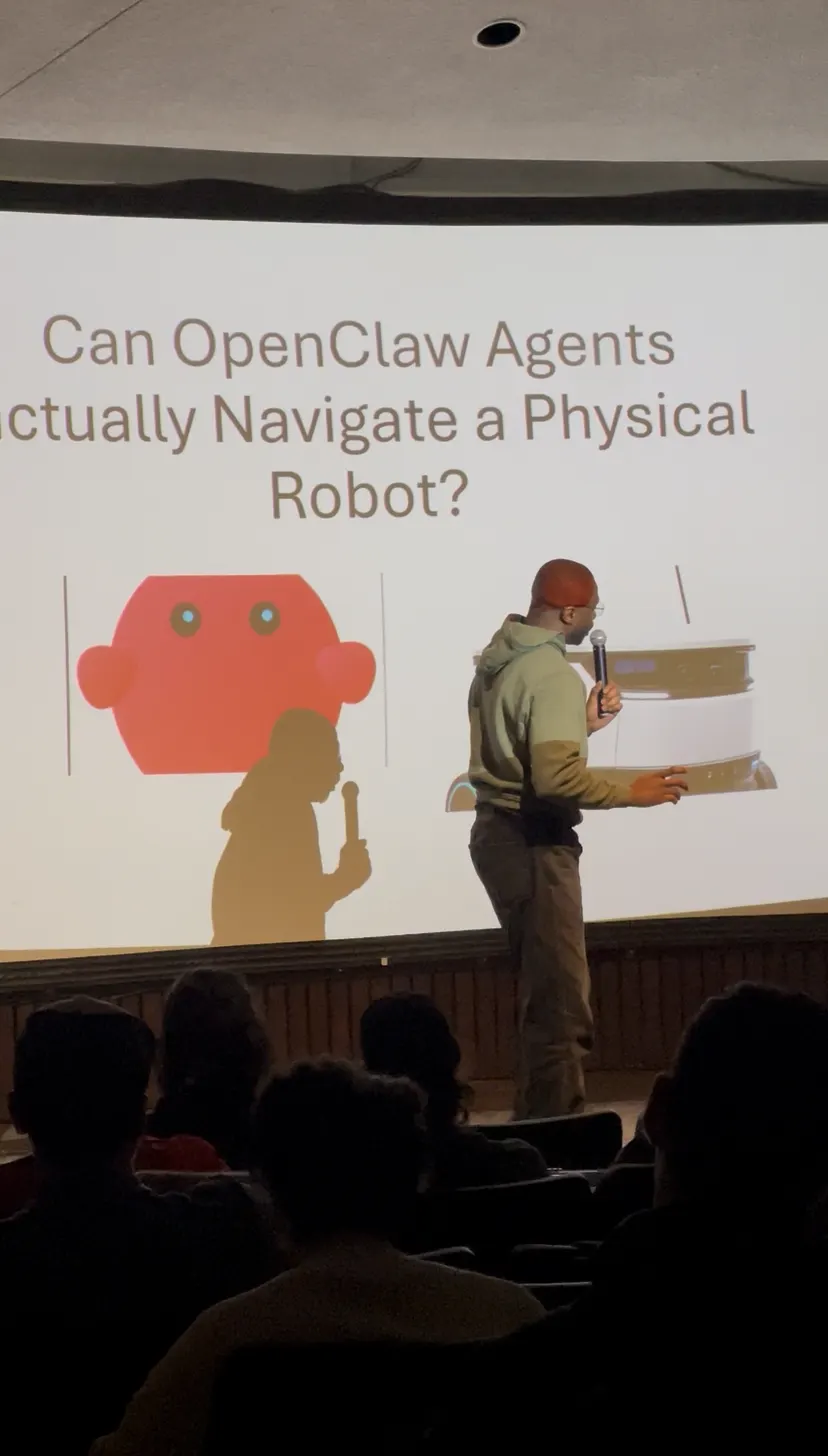
The problem
Large language model agents are good at understanding what people want. Robots are good at moving through the world. The gap between them is plumbing: topics, message types, coordinate frames, velocity commands, camera streams, and the safety logic that decides what a robot is allowed to do. Most agent-robot demos hard-wire one model to one robot. Change the agent or the robot and you start again.
I wanted the opposite: one interface layer that any agent can sit on top of, and any ROS 2 robot can sit under.
How AgenticROS works
AgenticROS started from ROSClaw's hackathon prototype and was rewritten from the ground up to be agent-agnostic. It has three parts:
- A platform-agnostic core that talks to ROS 2 over rosbridge, Zenoh, a local transport, or WebRTC, with a shared, validated config schema. The core knows nothing about any AI platform.
- Adapters for each agent platform: a plugin for OpenClaw, an MCP server for Claude Code and Claude desktop, and function calling for Gemini CLI. Each adapter registers the robot's tools with its agent and hands every ROS 2 call to the core.
- A ROS 2 workspace with discovery, agent, and follow-me packages, so the robot can describe what it has and run behaviours on its own side.
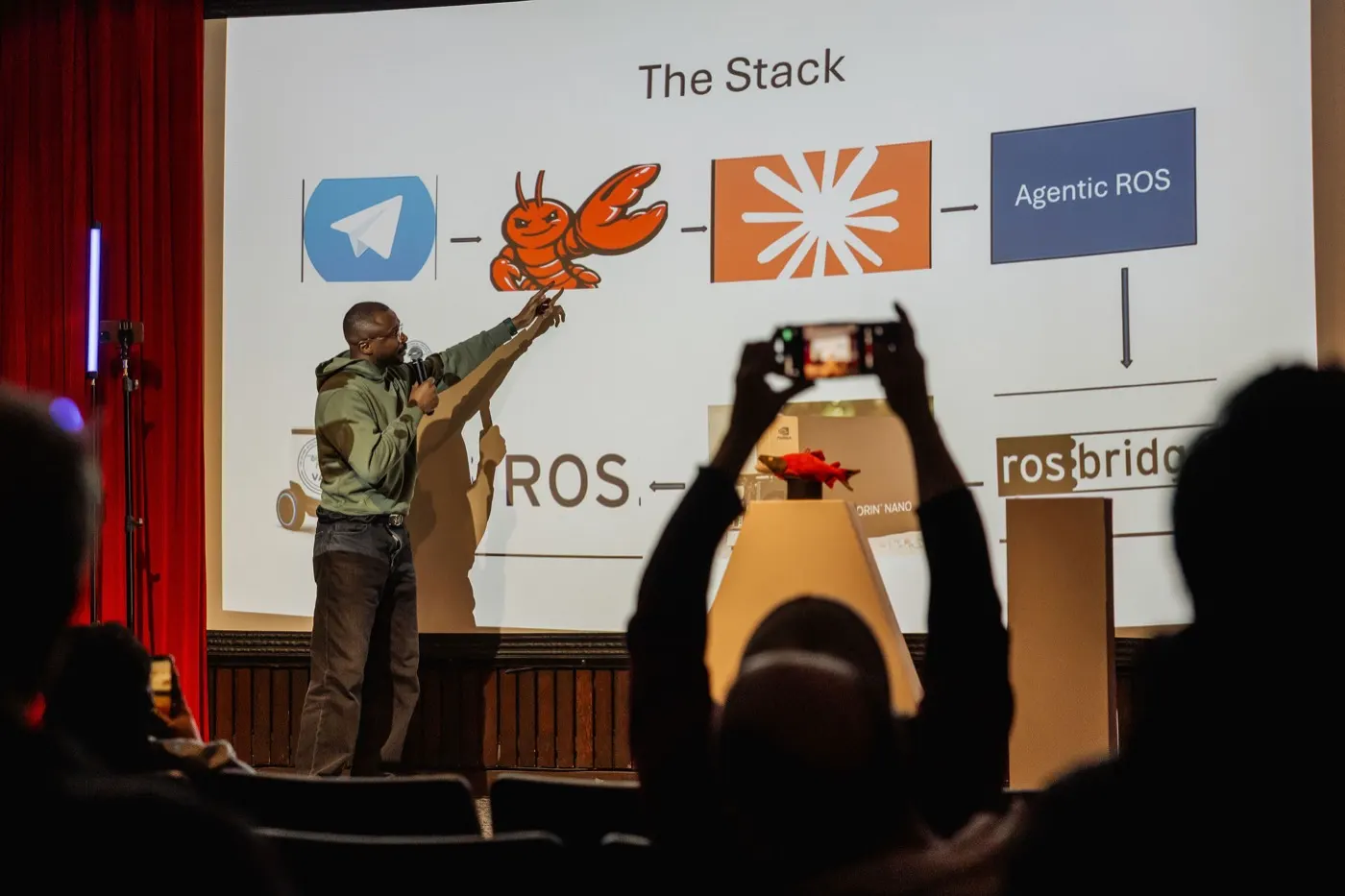
The live demo
On stage, a message sent from a phone went to an OpenClaw agent. The agent reasoned about the request with Claude, called AgenticROS tools, and those tools published real ROS 2 commands through rosbridge to a robot running on an NVIDIA Jetson Orin Nano. The same setup answers questions like “what do you see?” by reading the robot's camera, not just moving it.
Live robot demos are unforgiving: a dropped connection or a wrong frame and the robot simply doesn't move. Getting it to run cleanly in front of a full room was the real test of the design.
Why it matters for VASI
At VASI we're building robots that work inside hospitals, where the people giving instructions are nurses and porters, not roboticists. Plain-language control is the interface that makes a hospital robot usable. AgenticROS is how we keep that interface open, so it works with the agent a hospital already trusts and the robots it already owns.
The code is on GitHub. If you run a meetup or conference and want a live robot demo, invite me.